Posts

Showing posts with the label Barcelona

World Trade Center Barcelona Photo Sculpture

Image
World Trade Center Barcelona , 1999 Moll de Barcelona Barcelona, March 2017 �World Trade Center Barcelona is a business park located in Barcelona, opened on 22 July 1999. This business centre is located on the waterfront close to the city centre, and has 40,000 m2 of rented office and a conference centre, conventions and meeting spaces with 20 different rooms. WTCB building structure was inspired by the shape of a boat surrounded by the Mediterranean Sea, and created by American architect Henry N. Cobb. The arrangement of the four buildings in a circle creates a central plaza of 2,500 m2, where shops and restaurants provide services to the users of the complex. The four towers house offices for rent, a congress centre and the Hotel Grand Marina. Complex design allows to rent offices from 40 to 3,000 m2 in a single plant. The flexibility of space is also a feature of the convention centre, offering the possibility of organising meetings of 8 to large events with up to 1,500 attendees.� ...

La sardana Photo Sculpture

Image
�La sardana� by Josep Ca�as i Ca�as, 1965 Carretera de Montju�c, Montju�c Barcelona, March 2017 �The sardana is a type of circle dance typical of Catalan culture. The dance was originally from the Empord� region, but started gaining popularity throughout Catalonia during the 20th century. There are two main types, the original sardana curta (short sardana) style and the more modern sardana llarga (long sardana), which is more popular. Other more unusual sardanes are the sardana de llu�ment and the sardana revessa .� ( Sardana , Wikipedia)

Palau G�ell Photo Sculpture

Image
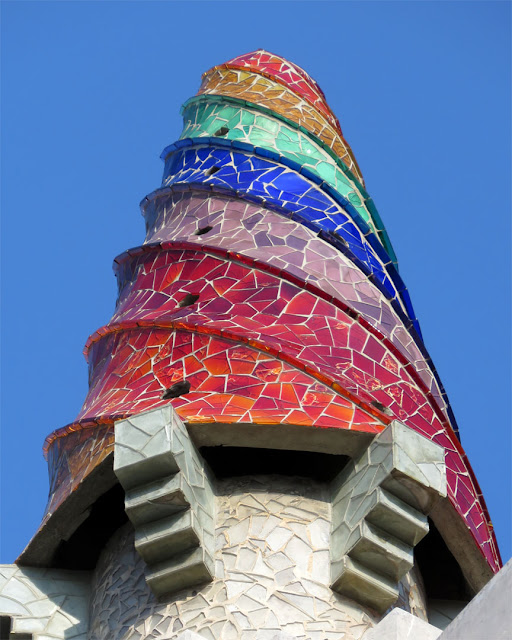
Detail of a chimney, Palau G�ell by Antoni Gaud� , 1888 Carrer Nou de la Rambla, El Raval Barcelona, March 2017 �The Palau G�ell (G�ell Palace) is a mansion designed by the architect Antoni Gaud� for the industrial tycoon Eusebi G�ell and built between 1886 and 1888. It is situated on the Carrer Nou de la Rambla, in the El Raval neighbourhood of the city of Barcelona in Catalonia, Spain. It is part of the UNESCO World Heritage Site �Works of Antoni Gaud�. The home is centered around the main room for entertaining high society guests. Guests entered the home in horse-drawn carriages through the front iron gates, which featured a parabolic arch and intricate patterns of forged ironwork resembling seaweed and in some parts a horsewhip. Animals could be taken down a ramp and kept in the livery stable in the basement where the servants resided, while the guests went up the stairs to the receiving room. The ornate walls and ceilings of the receiving room disguised small viewing windows high...

Tibidabo Photo Sculpture

Image
Temple Expiatori del Sagrat Cor (Expiatory Church of the Sacred Heart of Jesus) Tibidabo Amusement Park Tibidabo , Collserola Ridge Barcelona, March 2017 �Tibidabo is a mountain overlooking Barcelona, Catalonia, Spain. At 512 metres (1,680 ft), it is the tallest mountain in the Serra de Collserola. Rising sharply to the north-west, it affords spectacular views over the city and the surrounding coastline. The summit of the mountain is occupied by the Sagrat Cor church and adjacent Tibidabo Amusement Park. The Torre de Collserola telecommunications tower is a short walk away. All three are prominently visible from most of the city of Barcelona. Designed by Enric Sagnier, the church took 60 years to construct and is topped by a sculpture of the Sacred Heart of Jesus by Josep Miret Llopart. Tibidabo can be reached via the Tibidabo Funicular, which was the first of its kind in Spain, and by the Tramvia Blau or road. The Transports Metropolitans de Barcelona minibus service 111 connects it t...

Dragon and Umbrella Photo Sculpture

Image
Chinese dragon and umbrella, Casa Bruno Cuadros Casa dels Paraig�es (House of Umbrellas) La Rambla / Pla de la Boqueria Barcelona, March 2017 �La Rambla is an endless box of surprises. A box that opens and allows us to glimpse jewels, including this allegory to Orientalism, the Casa Bruno Cuadros, which used to be an umbrella shop of Barcelona in its time. Its style, similar to modernisme with its use of colour and the delicacy of its decorations, have made the Casa Bruno Cuadros a worthy addition to the photograph albums of many of Barcelona�s visitors. It was 1883 when the architect Josep Vilaseca undertook the refurbishment of the Casa Bruno Cuadros and the umbrella shop on the ground floor. It was just a few years before the 1888 Universal Exhibition and Barcelona was in the throes of expansion, with interesting buildings being built all over the city. The Catalan home-grown art-nouveau movement, modernisme, was gaining momentum and, with it, the taste for Oriental decorations. The...

The Palau de la M�sica Catalana Photo Sculpture

Image
Palau de la M�sica Catalana by Llu�s Dom�nech i Montaner, 1908 Carrer de Sant Pere M�s Alt Barcelona, March 2017 �The Palau de la M�sica Catalana (Palace of Catalan Music) is a concert hall in Barcelona, Catalonia, Spain. Designed in the Catalan modernista style by the architect Llu�s Dom�nech i Montaner, it was built between 1905 and 1908 for the Orfe� Catal�, a choral society founded in 1891 that was a leading force in the Catalan cultural movement that came to be known as the Renaixen�a (Catalan Rebirth). It was inaugurated February 9, 1908. The project was financed primarily by the society, but important financial contributions also were made by Barcelonas wealthy industrialists and bourgeoisie. The Palau won the architect an award from the Barcelona City Council in 1909, given to the best building built during the previous year. Between 1982 and 1989, the building underwent extensive restoration, remodeling, and extension under the direction of architects Oscar Tusquets and Carle...

The Palau de la M�sica Catalana Photo Sculpture

Image
Palau de la M�sica Catalana by Llu�s Dom�nech i Montaner, 1908 Carrer de Sant Pere M�s Alt Barcelona, March 2017 �The Palau de la M�sica Catalana (Palace of Catalan Music) is a concert hall in Barcelona, Catalonia, Spain. Designed in the Catalan modernista style by the architect Llu�s Dom�nech i Montaner, it was built between 1905 and 1908 for the Orfe� Catal�, a choral society founded in 1891 that was a leading force in the Catalan cultural movement that came to be known as the Renaixen�a (Catalan Rebirth). It was inaugurated February 9, 1908. The project was financed primarily by the society, but important financial contributions also were made by Barcelona's wealthy industrialists and bourgeoisie. The Palau won the architect an award from the Barcelona City Council in 1909, given to the best building built during the previous year. Between 1982 and 1989, the building underwent extensive restoration, remodeling, and extension under the direction of architects Oscar Tusquets and ...

El gat del Raval Photo Sculpture

Image
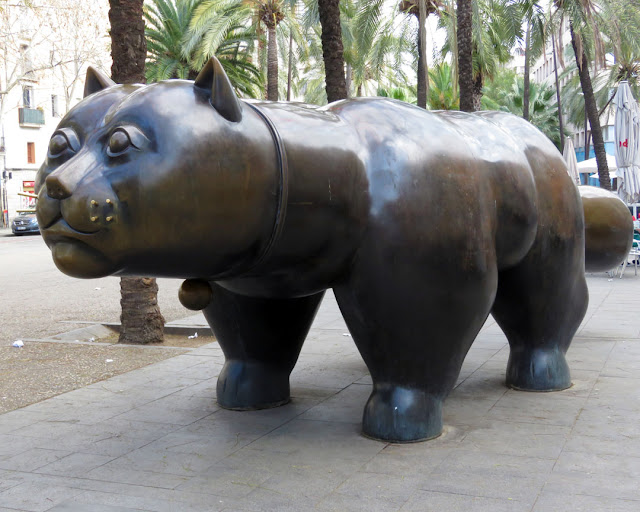
�Gato� (Cat) by Francesco Botero , 1990 Rambla del Raval Barcelona, March 2017 �Fernando Boteros Cat was purchased by Barcelona City Council in 1987. From then until 2003 the cat wandered the citys streets in search of a permanent site. His first stop-off point was the Parc de la Ciutadella, near his fellow animals at Barcelona Zoo. Then he was taken to a site by the Olympic Stadium, and a few years later he was put in a little square behind Barcelonas medieval shipyards. Finally, in 2003, the decision was taken to move him to a permanent location at the end of the newly created Rambla del Raval. It is maybe because cats have nine lives, that he has made his presence so strongly felt. Everybody recognises the figure of the bronze cat, with his chubby, rounded form, childish features and long tail. The sculpture has become an integral part of one of Barcelonas most widely redeveloped areas and is a favourite meeting place. Some brave souls even clamber onto the cats back to have their p...

El gat del Raval Photo Sculpture

Image
�Gato� (Cat) by Francesco Botero , 1990 Rambla del Raval Barcelona, March 2017 �Fernando Botero's Cat was purchased by Barcelona City Council in 1987. From then until 2003 the cat wandered the city's streets in search of a permanent site. His first stop-off point was the Parc de la Ciutadella, near his fellow animals at Barcelona Zoo. Then he was taken to a site by the Olympic Stadium, and a few years later he was put in a little square behind Barcelona's medieval shipyards. Finally, in 2003, the decision was taken to move him to a permanent location at the end of the newly created Rambla del Raval. It is maybe because cats have nine lives, that he has made his presence so strongly felt. Everybody recognises the figure of the bronze cat, with his chubby, rounded form, childish features and long tail. The sculpture has become an integral part of one of Barcelona's most widely redeveloped areas and is a favourite meeting place. Some brave souls even clamber onto the cat...

Torre de Collserola Photo Sculpture

Image
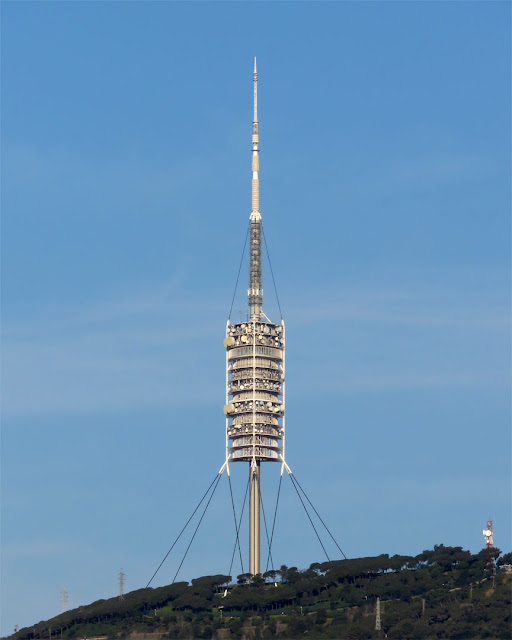
Torre de Collserola by Norman Foster , 1991 Carretera de Vallvidrera al Tibidabo Barcelona, March 2017 �Torre de Collserola is a uniquely designed tower located on the Tibidabo hill in the Serra de Collserola, in Barcelona, Catalonia, Spain. It was designed by the architect Sir Norman Foster and by the Spanish civil engineers Julio Mart�nez Calz�n and Manuel Juli� Vilardell. This emblematic tower was built in 1991 by the construction company Cubiertas y MZOV S.A. for the 1992 Summer Olympics. It features a pod for floor space like many towers but uses guy wires for lateral support like a mast. Mainly used as a TV and radio transmitter, this futuristic design provides the highest viewpoint over the city. The top antenna reaches 288.4 m (946 ft) and the top of the pod, which has thirteen floors, reaches 152 m (499 ft). The highest point of this tower is actually the highest place you could be in the city of Barcelona.� ( Torre de Collserola , Wikipedia)

Montju�c Communications Tower Photo Sculpture

Image
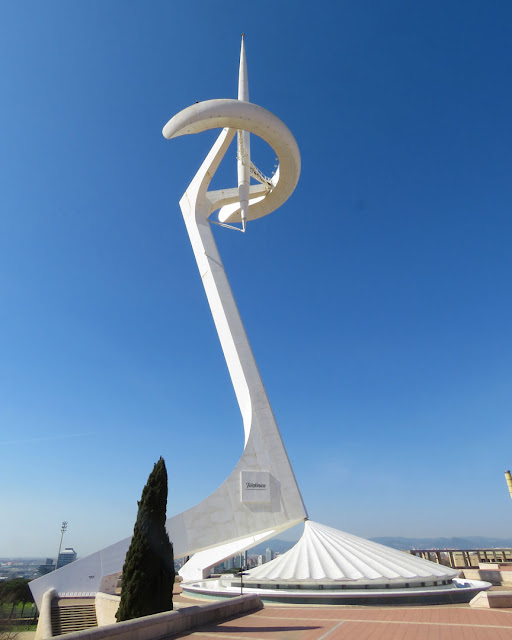
Montju�c Communications Tower by Santiago Calatrava , 1992 Anella Ol�mpica (Olympic Ring) Passeig Ol�mpic, Montju�c Barcelona, March 2017 �The Montju�c Communications Tower, popularly known as Torre Calatrava and Torre Telef�nica, is a telecommunication tower in the Montju�c neighborhood of Barcelona, Catalonia, Spain. It was designed by Santiago Calatrava, with construction taking place from 1989 to 1992. The white tower was built for Telef�nica to transmit television coverage of the 1992 Summer Olympic Games in Barcelona. The 136-metre (446 ft) tower is located in the Olympic park and represents an athlete holding the Olympic Flame. The base is covered with trencad�s, Gaud�s mosaic technique created from broken tile shards. Because of the towers orientation, it works also as a giant sundial, which uses the Europa square to indicate the hour.� ( Montju�c Communications Tower , Wikipedia)

Montju�c Communications Tower Photo Sculpture

Image
Montju�c Communications Tower by Santiago Calatrava , 1992 Anella Ol�mpica (Olympic Ring) Passeig Ol�mpic, Montju�c Barcelona, March 2017 �The Montju�c Communications Tower, popularly known as Torre Calatrava and Torre Telef�nica, is a telecommunication tower in the Montju�c neighborhood of Barcelona, Catalonia, Spain. It was designed by Santiago Calatrava, with construction taking place from 1989 to 1992. The white tower was built for Telef�nica to transmit television coverage of the 1992 Summer Olympic Games in Barcelona. The 136-metre (446 ft) tower is located in the Olympic park and represents an athlete holding the Olympic Flame. The base is covered with trencad�s, Gaud�'s mosaic technique created from broken tile shards. Because of the tower's orientation, it works also as a giant sundial, which uses the Europa square to indicate the hour.� ( Montju�c Communications Tower , Wikipedia)

Casa Trias Photo Sculpture

Image
Casa Mart� Trias i Dom�nech by Juli Batllevell, 1905 Parc G�ell Barcelona, March 2017 �October 1900 saw the start of work on dividing the site into levels, with building work proceeding at a good pace. On 4 January 1903, a description published in the Anuari de l�Associaci� d�Arquitectes (Association of Architects Year Book) noted that the two entrance pavilions had been constructed, as well as the main flight of steps, the shelter for horse-drawn carriages, the outer enclosure, the viaducts and part of the great esplanade, together with the water evacuation system. By 1907 events were already being held in the great square, from which we know that the hypostyle room was entirely covered by then, while the tiled bench running around it was completed in 1914. The first person to buy a plot in the Park, in 1902, was a friend of G�ell, lawyer Mart� Trias i Dom�nech, who commissioned architect Juli Batllevell with building his villa. At the same time, the works contractor, Josep Pardo i Ca...

Las Golondrinas Photo Sculpture

Image
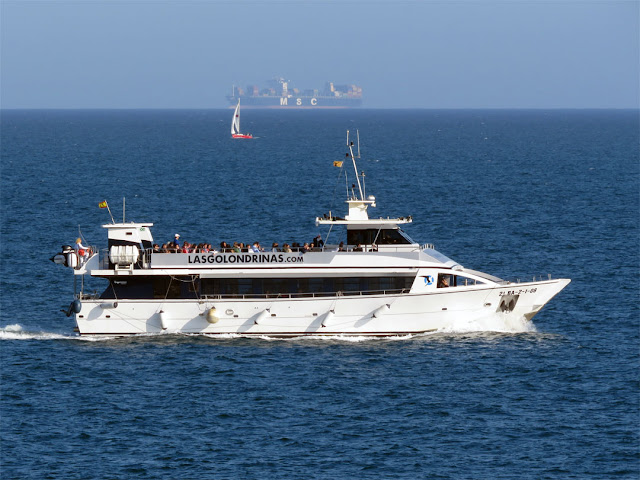
One of the �Golondrinas� tourist boat Seen from Pla�a Rosa dels Vents Barcelona, March 2017 � Barcelona Mar offers for 1h30 the opportunity to visit the port, coastline and beaches of Barcelona. The ship sails from the Portal de la Pau (next to the Drassanes pier, under the Col�n monument), and travel 9 miles sailing along the coast of Barcelona showing the main buildings that make up the city skyline. It is a perfect activity for children, as it is a unique opportunity to enjoy nature and different view of the city, while allowing you to discover all its emblematic monuments, symbols of the culture of Barcelona.� ( Las Golondrinas de Barcelona )

Las Golondrinas Photo Sculpture

Image
One of the �Golondrinas� tourist boat Seen from Pla�a Rosa dels Vents Barcelona, March 2017 � Barcelona Mar offers for 1h30' the opportunity to visit the port, coastline and beaches of Barcelona. The ship sails from the Portal de la Pau (next to the Drassanes pier, under the Col�n monument), and travel 9 miles sailing along the coast of Barcelona showing the main buildings that make up the city skyline. It is a perfect activity for children, as it is a unique opportunity to enjoy nature and different view of the city, while allowing you to discover all its emblematic monuments, symbols of the culture of Barcelona.� ( Las Golondrinas de Barcelona )

Barcelona Cathedral Photo Sculpture

Image
Catedral de la Santa Creu i Santa Eul�lia (Cathedral of the Holy Cross and Saint Eulalia) Pla de la Seu Barcelona, March 2017 �The Cathedral of the Holy Cross and Saint Eulalia (Catalan: Catedral de la Santa Creu i Santa Eul�lia , Spanish: Catedral de la Santa Cruz y Santa Eulalia ), also known as Barcelona Cathedral , is the Gothic cathedral and seat of the Archbishop of Barcelona, Spain. The cathedral was constructed from the 13th to 15th centuries, with the principal work done in the 14th century. The cloister, which encloses the Well of the Geese (Font de les Oques) was completed in 1448. In the late 19th century, the neo-Gothic fa�ade was constructed over the nondescript exterior that was common to Catalan churches. The roof is notable for its gargoyles, featuring a wide range of animals, both domestic and mythical.� ( Barcelona Cathedral , Wikipedia)

Palau Sant Jordi Photo Sculpture

Image
Palau Sant Jordi by Arata Isozaki , 1990 Anella Ol�mpica (Olympic Ring) Passeig Ol�mpic, Montju�c Barcelona, March 2017 �Palau Sant Jordi (St. Georges Palace) is an indoor sporting arena and multi-purpose installation that is part of the Olympic Ring complex located in Barcelona, Catalonia, Spain. Designed by the Japanese architect Arata Isozaki, it was opened in 1990. The maximum seating capacity of the arena is 16,670 for basketball, and 24,000 for musical events. It is the largest indoor arena in Spain. The Palau Sant Jordi was one of the main venues of the 1992 Summer Olympics hosting the artistic gymnastics, handball final, and volleyball final events. Today, it is used for all kinds of indoor sport events as well as for concerts and other cultural activities, due to its great flexibility.� ( Palau Sant Jordi , Wikipedia)

Palau Sant Jordi Photo Sculpture

Image
Palau Sant Jordi by Arata Isozaki , 1990 Anella Ol�mpica (Olympic Ring) Passeig Ol�mpic, Montju�c Barcelona, March 2017 �Palau Sant Jordi (St. George's Palace) is an indoor sporting arena and multi-purpose installation that is part of the Olympic Ring complex located in Barcelona, Catalonia, Spain. Designed by the Japanese architect Arata Isozaki, it was opened in 1990. The maximum seating capacity of the arena is 16,670 for basketball, and 24,000 for musical events. It is the largest indoor arena in Spain. The Palau Sant Jordi was one of the main venues of the 1992 Summer Olympics hosting the artistic gymnastics, handball final, and volleyball final events. Today, it is used for all kinds of indoor sport events as well as for concerts and other cultural activities, due to its great flexibility.� ( Palau Sant Jordi , Wikipedia)