Posts

Showing posts with the label church

Blue Church Photo Sculpture

Image
Church of St. Elizabeth (Kostol sv�tej Al�bety) Bezrucova Bratislava, September 2017 �The Church of St. Elizabeth (Slovak: Kostol sv�tej Al�bety , Hungarian: Szent Erzs�bet templom ), commonly known as Blue Church ( Modr� kostol�k, K�k templom ), is a Hungarian Secessionist (Jugendstil, Art Nouveau) Catholic church located in the eastern part of the Old Town in Bratislava, present day Slovakia. It is consecrated to Elisabeth of Hungary, daughter of Andrew II, who grew up in the Pressburg Castle ( pozsonyi v�r ). It is referred to as �The Little Blue Church� because of the colour of its fa�ade, mosaics, majolicas and blue-glazed roof. It was initially part of the neighboring gymn�zium (high school) and served as the school chapel.� ( Blue Church , Wikipedia)
San Michele in Foro Photo Sculpture

Image
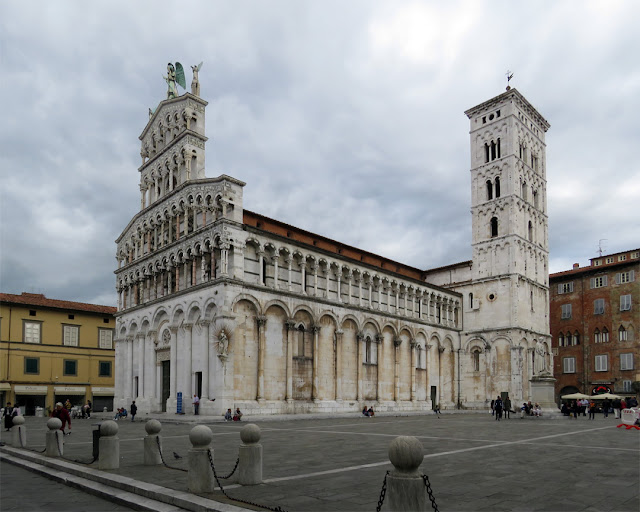
San Michele in Foro Piazza San Michele Lucca, October 2017 �San Michele in Foro is a Roman Catholic basilica church in Lucca, Tuscany, central Italy, built over the ancient Roman forum. Until 1370 it was the seat of the Consiglio Maggiore (Major Council), the communes most important assembly. It is dedicated to Archangel Michael. The church is mentioned for the first time in 795 as ad foro (in the forum). It was rebuilt after 1070 by will of Pope Alexander II. Notable is the fa�ade, from the 13th century, with a large series of sculptures and inlays, numerous of which remade in the 19th century. The lower part has a series of blind arcades, the central of which includes the main portal. The upper part, built using plenty of iron materials to counter wind, has four orders of small loggias. On the summit, flanked by two other angels, is the 4 m-tall statue of St. Michael the Archangel. According to a legend, an angels finger would have a huge diamond. On the lower right corner of the fa�...

San Michele in Foro Photo Sculpture

Image
San Michele in Foro Piazza San Michele Lucca, October 2017 �San Michele in Foro is a Roman Catholic basilica church in Lucca, Tuscany, central Italy, built over the ancient Roman forum. Until 1370 it was the seat of the Consiglio Maggiore (Major Council), the commune's most important assembly. It is dedicated to Archangel Michael. The church is mentioned for the first time in 795 as ad foro (in the forum). It was rebuilt after 1070 by will of Pope Alexander II. Notable is the fa�ade, from the 13th century, with a large series of sculptures and inlays, numerous of which remade in the 19th century. The lower part has a series of blind arcades, the central of which includes the main portal. The upper part, built using plenty of iron materials to counter wind, has four orders of small loggias. On the summit, flanked by two other angels, is the 4 m-tall statue of St. Michael the Archangel. According to a legend, an angel's finger would have a huge diamond. On the lower right corner ...

Holy Apostles Photo Sculpture

Image
Bell tower of the church of the Santi Apostoli di Cristo ( Holy Apostles of Christ ) by Alessandro Vittoria 1575 Campo Santi Apostoli, Cannaregio Venice, September 2013 �The 7th Century campanile was destroyed by the fire of 1105. Rebuilt 1450, renovated 1601-09 by Francesco di Piero, brought down by a storm in 1659 and rebuilt 1672-1720 to a design by Andrea Tirali. Jan Morris says that an old and simple sacristan fell from the campanile soon after its completion in 1672(?) but was caught by the minute hand on the clock, and so was slowly lowered to a parapet as time passed.� ( Santi Apostoli , The Churches of Venice)

Holy Apostles Photo Sculpture

Image
Bell tower of the church of the Santi Apostoli di Cristo ( Holy Apostles of Christ ) by Alessandro Vittoria 1575 Campo Santi Apostoli, Cannaregio Venice, September 2013 �The 7th Century campanile was destroyed by the fire of 1105. Rebuilt 1450, renovated 1601-09 by Francesco di Piero, brought down by a storm in 1659 and rebuilt 1672-1720 to a design by Andrea Tirali. Jan Morris says that an 'old and simple' sacristan fell from the campanile soon after its completion in 1672(?) but was caught by the minute hand on the clock, and so was slowly lowered to a parapet as time passed.� ( Santi Apostoli , The Churches of Venice)

Facade of San Miniato Photo Sculpture

Image
Facade of San Miniato al Monte (St. Minias on the Mountain) Viale dei Colli Florence, April 2015 �St. Miniato or Minas was an Armenian prince serving in the Roman army under Emperor Decius. He was denounced as a Christian after becoming a hermit and was brought before the Emperor who was camped outside the gates of Florence. The Emperor ordered him to be thrown to beasts in the Amphitheatre where a panther was called upon him but refused to devour him. Beheaded in the presence of the Emperor, he is alleged to have picked up his head, crossed the Arno and walked up the hill of Mons Fiorentinus to his hermitage. A shrine was later erected at this spot and there was a chapel there by the 8th century. Construction of the present church was begun in 1013 by Bishop Alibrando and it was endowed by the Emperor Henry II. The adjoining monastery began as a Benedictine community, then passed to the Cluniacs and then in 1373 to the Olivetans, who still run it. The monks make famous liqueurs, hone...

The Dome and the Bell Tower Photo Sculpture

Image
The dome and the bell tower of the Duomo di Siena ( Siena Cathedral ) Piazza del Duomo Siena, April 2017 �The cathedral itself was originally designed and completed between 1215 and 1263 on the site of an earlier structure. It has the form of a Latin cross with a slightly projecting transept, a dome and a bell tower. The dome rises from a hexagonal base with supporting columns. The lantern atop the dome was added by Gian Lorenzo Bernini. The nave is separated from the two aisles by semicircular arches. The exterior and interior are constructed of white and greenish-black marble in alternating stripes, with addition of red marble on the fa�ade. Black and white are the symbolic colors of Siena, etiologically linked to black and white horses of the legendary citys founders, Senius and Aschius.� ( Siena Cathedral , Wikipedia)

The Dome and the Bell Tower Photo Sculpture

Image
The dome and the bell tower of the Duomo di Siena ( Siena Cathedral ) Piazza del Duomo Siena, April 2017 �The cathedral itself was originally designed and completed between 1215 and 1263 on the site of an earlier structure. It has the form of a Latin cross with a slightly projecting transept, a dome and a bell tower. The dome rises from a hexagonal base with supporting columns. The lantern atop the dome was added by Gian Lorenzo Bernini. The nave is separated from the two aisles by semicircular arches. The exterior and interior are constructed of white and greenish-black marble in alternating stripes, with addition of red marble on the fa�ade. Black and white are the symbolic colors of Siena, etiologically linked to black and white horses of the legendary city's founders, Senius and Aschius.� ( Siena Cathedral , Wikipedia)

Detail of Santa Croce Photo Sculpture

Image
Basilica di Santa Croce ( Basilica of the Holy Cross ) Piazza Santa Croce Florence, May 2017 �The Basilica is the largest Franciscan church in the world. Its most notable features are its sixteen chapels, many of them decorated with frescoes by Giotto and his pupils, and its tombs and cenotaphs. Legend says that Santa Croce was founded by St Francis himself. The construction of the current church, to replace an older building, was begun on 12 May 1294, possibly by Arnolfo di Cambio, and paid for by some of the citys wealthiest families. It was consecrated in 1442 by Pope Eugene IV. The buildings design reflects the austere approach of the Franciscans. The floorplan is an Egyptian or Tau cross (a symbol of St Francis), 115 metres in length with a nave and two aisles separated by lines of octagonal columns. To the south of the church was a convent, some of whose buildings remain.� ( Santa Croce , Wikipedia)

Detail of Santa Croce Photo Sculpture

Image
Basilica di Santa Croce ( Basilica of the Holy Cross ) Piazza Santa Croce Florence, May 2017 �The Basilica is the largest Franciscan church in the world. Its most notable features are its sixteen chapels, many of them decorated with frescoes by Giotto and his pupils, and its tombs and cenotaphs. Legend says that Santa Croce was founded by St Francis himself. The construction of the current church, to replace an older building, was begun on 12 May 1294, possibly by Arnolfo di Cambio, and paid for by some of the city's wealthiest families. It was consecrated in 1442 by Pope Eugene IV. The building's design reflects the austere approach of the Franciscans. The floorplan is an Egyptian or Tau cross (a symbol of St Francis), 115 metres in length with a nave and two aisles separated by lines of octagonal columns. To the south of the church was a convent, some of whose buildings remain.� ( Santa Croce , Wikipedia)

St Waltrude Photo Sculpture

Image
Collegiate Church of St Waltrude Rue du Chapitre Mons (Bergen), March 1994

Cloister of Santo Stefano Photo Sculpture

Image
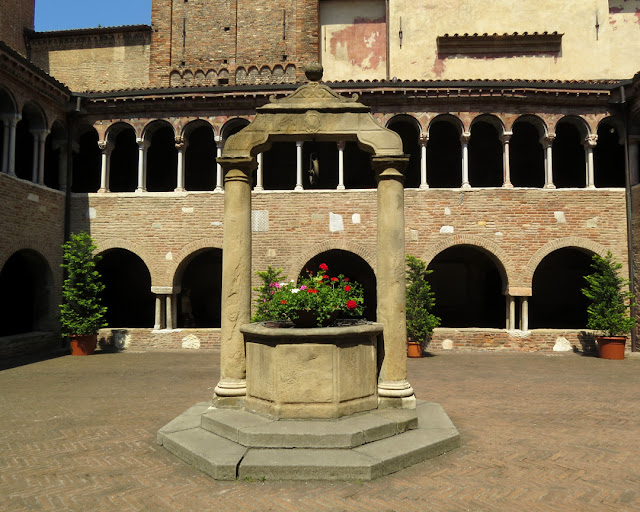
Cloister of the Basilica of Santo Stefano Piazza Santo Stefano Bologna, June 2015 �The focus of scholarly discussion has been for many years the supposed similarity between the so-called �New Jerusalem� rebuilt here, according to a vita written in 1180, by Saint Petronius in the 5th century, and the largely lost 4th-century complex erected by Constantine the Great at the purported site of the crucifixion and resurrection of Jesus. Unfortunately the archaeological evidence from Bologna dates primarily to the 11th and 12th centuries, leaving the question about an earlier date still unanswered (at least until 1981). On the other hand, archaeology has meanwhile delivered many answers regarding the Constantinian church complex from Jerusalem, therefore the main interest presented by the 12th-century parts of the Church of Santo Stefano might much rather be their similarity to the almost contemporary Crusader Church of the Holy Sepulchre from Jerusalem, of which not all parts are preserved.�...

Santa Maria dei Miracoli Photo Sculpture

Image
Church of Santa Maria dei Miracoli Campiello dei Miracoli, Cannaregio Venice, September 2013 �Santa Maria dei Miracoli is a church in the sestiere of Cannaregio, in Venice, Italy. Also known as the �marble church�, it is one of the best examples of the early Venetian Renaissance including colored marble, a false colonnade on the exterior walls (pilasters), and a semicircular pediment. The organisation �Save Venice� restored the church over a period of ten years, from 1987 to 1997 (they had estimated as period of two years). The marble cladding contained 14 percent of salts, and was on the point of bursting. All marble cladding was removed, and cleaned in stainless steel tanks, in a solution of distilled water. The restoration was calculated to cost 1 million dollars, the final cost was 4 million dollars. The main altar is reached by a series of steps. The circular facade windows recall Donato Bramantes churches in Milan.� ( Church of Santa Maria dei Miracoli , Wikipedia)

Santa Maria dei Miracoli Photo Sculpture

Image
Church of Santa Maria dei Miracoli Campiello dei Miracoli, Cannaregio Venice, September 2013 �Santa Maria dei Miracoli is a church in the sestiere of Cannaregio, in Venice, Italy. Also known as the �marble church�, it is one of the best examples of the early Venetian Renaissance including colored marble, a false colonnade on the exterior walls (pilasters), and a semicircular pediment. The organisation �Save Venice� restored the church over a period of ten years, from 1987 to 1997 (they had estimated as period of two years). The marble cladding contained 14 percent of salts, and was on the point of bursting. All marble cladding was removed, and cleaned in stainless steel tanks, in a solution of distilled water. The restoration was calculated to cost 1 million dollars, the final cost was 4 million dollars. The main altar is reached by a series of steps. The circular facade windows recall Donato Bramante's churches in Milan.� ( Church of Santa Maria dei Miracoli , Wikipedia)

St Brides Church Photo Sculpture

Image
The spire of St Brides Church Fleet Street, City of London London, September 2016 �St Brides Church is a church in the City of London, England. The buildings most recent incarnation was designed by Sir Christopher Wren in 1672 in Fleet Street in the City of London, though Wrens original building was largely gutted by fire during the London Blitz in 1940. Due to its location in Fleet Street, it has a long association with journalists and newspapers. The church is a distinctive sight on Londons skyline and is clearly visible from a number of locations. Standing 226 feet (69m) high, it is the second tallest of all Wrens churches, with only St Pauls itself having a higher pinnacle.� ( St Brides Church , Wikipedia)

St Bride's Church Photo Sculpture

Image
The spire of St Bride's Church Fleet Street, City of London London, September 2016 �St Bride's Church is a church in the City of London, England. The building's most recent incarnation was designed by Sir Christopher Wren in 1672 in Fleet Street in the City of London, though Wren's original building was largely gutted by fire during the London Blitz in 1940. Due to its location in Fleet Street, it has a long association with journalists and newspapers. The church is a distinctive sight on London's skyline and is clearly visible from a number of locations. Standing 226 feet (69m) high, it is the second tallest of all Wren's churches, with only St Paul's itself having a higher pinnacle.� ( St Bride's Church , Wikipedia)

Childrens Sculpture Garden Photo Sculpture

Image
Childrens Sculpture Garden Cathedral of Saint John the Divine New York, September 2008 �The Childrens Sculpture Garden is located next to the Cathedral of St. John the Divine in the Morningside Heights of Manhattan. Within the garden are "Animals of Freedom" sculptures created by artists from kindergarten through high school that were selected in a public competition in 1985. The sculptures are placed around the ring of freedom. The centerpiece of the Childrens Sculpture Garden is the "Fountain of Peace" sculpture by Greg Wyatt, sculptor-in-residence at the Cathedral.� ( Childrens Sculpture Garden and the Fountain of Peace , NYC ? NYC)

Children's Sculpture Garden Photo Sculpture

Image
Children's Sculpture Garden Cathedral of Saint John the Divine New York, September 2008 �The Children's Sculpture Garden is located next to the Cathedral of St. John the Divine in the Morningside Heights of Manhattan. Within the garden are "Animals of Freedom" sculptures created by artists from kindergarten through high school that were selected in a public competition in 1985. The sculptures are placed around the ring of freedom. The centerpiece of the Children's Sculpture Garden is the "Fountain of Peace" sculpture by Greg Wyatt, sculptor-in-residence at the Cathedral.� ( Children's Sculpture Garden and the Fountain of Peace , NYC ? NYC)

Tibidabo Photo Sculpture

Image
Temple Expiatori del Sagrat Cor (Expiatory Church of the Sacred Heart of Jesus) Tibidabo Amusement Park Tibidabo , Collserola Ridge Barcelona, March 2017 �Tibidabo is a mountain overlooking Barcelona, Catalonia, Spain. At 512 metres (1,680 ft), it is the tallest mountain in the Serra de Collserola. Rising sharply to the north-west, it affords spectacular views over the city and the surrounding coastline. The summit of the mountain is occupied by the Sagrat Cor church and adjacent Tibidabo Amusement Park. The Torre de Collserola telecommunications tower is a short walk away. All three are prominently visible from most of the city of Barcelona. Designed by Enric Sagnier, the church took 60 years to construct and is topped by a sculpture of the Sacred Heart of Jesus by Josep Miret Llopart. Tibidabo can be reached via the Tibidabo Funicular, which was the first of its kind in Spain, and by the Tramvia Blau or road. The Transports Metropolitans de Barcelona minibus service 111 connects it t...

Fa�ade of the Madonna dellOrto Photo Sculpture

Image
Fa�ade of the church of the Madonna dellOrto Campo della Madonna dellOrto, Cannaregio Venice, September 2013 �The fa�ade, built in 1460�1464, has sloping sides and is in brickwork, divided in three parts by two pilasters strips. The two side sections have quadruple mullioned windows, while the central has a large rose window. The portal is surmounted by a pointed arch with white stone decorations portraying, on the summit, St. Christopher, the Madonna and the Archangel Gabriel by Nicol� di Giovanni Fiorentino and Antonio Rizzo. Under is a tympanum, in porphyry, supported by circular pilaster strips. The whole is included into a porch with Corinthian columns. The upper central section is decorated by small arches and bas-reliefs with geometrical motifs. The upper sides have instead twelve niches each, containing statues of the Apostles. Five other Gothic niches are in the central section, with 18th-century statues representing Prudence, Charity, Faith, Hope and Temperance, taken from th...