Posts

Showing posts with the label Berlin

Gargoyle in M�nzstra�e Photo Sculpture

Image
Residential and commercial building by Poentsch & Bohnstedt, 1893 M�nzstra�e 21/23 Berlin, September 2011

Neue Synagoge Photo Sculpture

Image
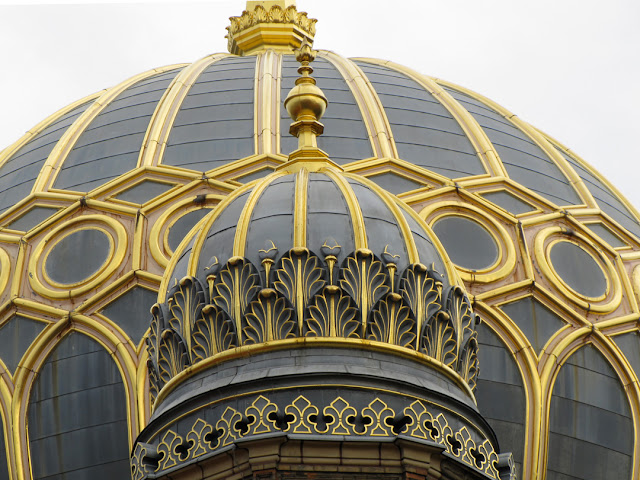
Neue Synagoge ( New Synagogue ), 1866 Oranienburger Stra�e Berlin, September 2011 �The front of the building, facing Oranienburger Stra�e, is richly ornamented with shaped bricks and terracotta, accented by coloured glazed bricks. Beyond the entrance, the buildings alignment changes to mesh with pre-existing structures. The synagogues main dome with its gilded ribs is an eye-catching sight. The central dome is flanked by two smaller pavilion-like domes on the two side-wings. Beyond the fa�ade was the front hall and the main hall with 3,000 seats. Due to the unfavourable alignment of the property, the buildings design required adjustment along a slightly turned axis. The Neue Synagoge is also a monument of early iron construction. The new building material (iron was previously not used in building construction) was visible in its use for the outside columns, as well as in the domes construction. (Iron was also a core component for the now-lost floor structure of the main hall.)� ( New S...

Neue Synagoge Photo Sculpture

Image
Neue Synagoge ( New Synagogue ), 1866 Oranienburger Stra�e Berlin, September 2011 �The front of the building, facing Oranienburger Stra�e, is richly ornamented with shaped bricks and terracotta, accented by coloured glazed bricks. Beyond the entrance, the building's alignment changes to mesh with pre-existing structures. The synagogue's main dome with its gilded ribs is an eye-catching sight. The central dome is flanked by two smaller pavilion-like domes on the two side-wings. Beyond the fa�ade was the front hall and the main hall with 3,000 seats. Due to the unfavourable alignment of the property, the building's design required adjustment along a slightly turned axis. The Neue Synagoge is also a monument of early iron construction. The new building material (iron was previously not used in building construction) was visible in its use for the outside columns, as well as in the dome's construction. (Iron was also a core component for the now-lost floor structure of the ...

Park Kolonnaden Photo Sculpture

Image
Park Kolonnaden at Potsdamer Platz, offices and commercial spaces, by Giorgio Grassi , 2001 Gabriele-Tergit-Promenade Berlin, September 2011

Double Schinkel Photo Sculpture

Image
Statue of Karl Friedrich Schinkel by Friedrich Drake, 1869 Schinkelplatz Berlin, September 2011 �Schinkel, however, is noted as much for his theoretical work and his architectural drafts as for the relatively few buildings that were actually executed to his designs. Some of his merits are best shown in his unexecuted plans for the transformation of the Athenian Acropolis into a royal palace for the new Kingdom of Greece and for the erection of the Orianda Palace in the Crimea. These and other designs may be studied in his Sammlung architektonischer Entw�rfe (1820�1837) and his Werke der h�heren Baukunst (1840�1842; 1845�1846). He also designed the famed Iron Cross medal of Prussia, and later Germany. It has been speculated, however, that due to the difficult political circumstances � French occupation and the dependency on the Prussian king � and his relatively early death, which prevented him from seeing the explosive German industrialization in the second half of the 19th century, h...

Delivery Bike Photo Sculpture

Image
Delivery bike, Deutsche Post Rudi-Dutschke-Stra�e Berlin, September 2013