Posts

Showing posts with the label sculpture

Gate of Palmyra Photo Sculpture

Image
Palmyras Triumphal Arch (Gate of Palmyra) Piazza della Signoria Florence, April 2017 At the centre of Palmyra is a spectacular colonnaded street. This thoroughfare interconnects with smaller side streets of similar style, linking together the citys temples and major public buildings. At the middle of it there was Palmyras Triumphal Arch, or gate of Palmyra as it is known by the Syrian people. This Roman archway was one of the most beautiful of the many notable monuments in the ancient city, built in the third century CE by Septimius Severus. In the late summer of 2015, the arch, together with a number of other important structures on the site, was reduced to rubble by extremists who had occupied the ancient city since the spring. The Institute for Digital Archaeology was, at that time, in the early stages of a documentation and cultural heritage protection project in collaboration with the people of the region. Plans were made to create a large scale reconstruction of one of the...

Bulgarian Partisans Photo Sculpture

Image
Memorial of the Bulgarian Partisans by F. David, 1949 Vajansk�ho n�bre�ie Bratislava, September 2017

Prince Eugene of Savoy Photo Sculpture

Image
Equestrian monument to Prince Eugene of Savoy, by Anton Dominik Fernkorn , 1865 Heldenplatz (Heroes Square) Vienna, September 2017 �On the plaza, there are two equestrian statues designed by Anton Dominik Fernkorn with socles by Eduard van der N�ll. The statue of Archduke Charles of Austria, modelled on a popular painting by Johann Peter Krafft, was inaugurated already in 1860. It was meant to glorify the Habsburg dynasty as great Austrian military leaders, though they just had suffered a crushing defeat at the bloody Battle of Solferino. The second statue of Prince Eugene of Savoy was inaugurated in 1865, one year before the Austrian defeat in the Battle of K�niggr�tz.� ( Heldenplatz , Wikipedia)

Prince Eugene of Savoy Photo Sculpture

Image
Equestrian monument to Prince Eugene of Savoy, by Anton Dominik Fernkorn , 1865 Heldenplatz (Heroes' Square) Vienna, September 2017 �On the plaza, there are two equestrian statues designed by Anton Dominik Fernkorn with socles by Eduard van der N�ll. The statue of Archduke Charles of Austria, modelled on a popular painting by Johann Peter Krafft, was inaugurated already in 1860. It was meant to glorify the Habsburg dynasty as great Austrian military leaders, though they just had suffered a crushing defeat at the bloody Battle of Solferino. The second statue of Prince Eugene of Savoy was inaugurated in 1865, one year before the Austrian defeat in the Battle of K�niggr�tz.� ( Heldenplatz , Wikipedia)

Alexandre Dumas Photo Sculpture

Image
Monument to Alexandre Dumas by Gustave Dor� , 1883 Place du G�n�ral-Catroux Quartier de la Plaine-de-Monceaux, 17e arrondissement Paris, July 2011

Sallustio Bandini Photo Sculpture

Image
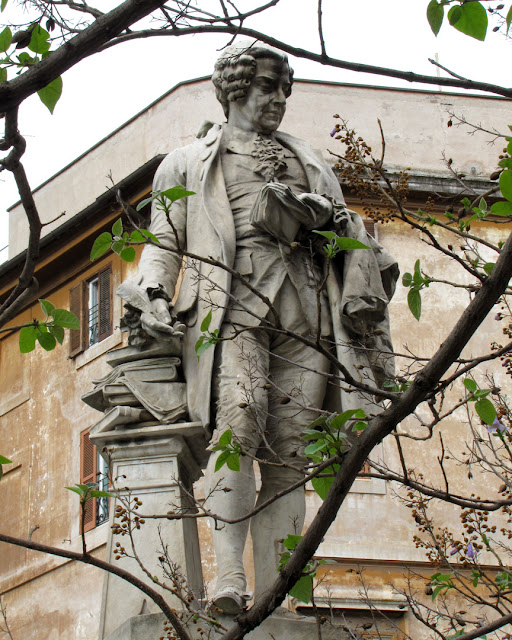
Statue of Sallustio Bandini by Tito Sarrocchi , 1880 Piazza Salimbeni Siena, April 2017 �Sallustio Bandini (19 April 1677 � 8 June 1760) was an Italian archdeacon, economist, and politician. He was an advocate of free trade, and removal of local feudal tariffs and tolls. He wrote an influential piece on this subject, titled Discorso Economico sopra la Maremma di Siena, published posthumously in 1775. Approximately two years before his death, Bandini donated his private library to the University of Siena, under the agreement that the almost 3000 volumes would be made publicly available. From this donation the Biblioteca della Sapienza was formed, now known as Biblioteca Comunale degli Intronati. Bandini was born Sallustio Antonio Bandini in Siena to a prominent local family. His father was Patrizio Bandini and his mother was Caterina Piccolomini di Modanella, a member of the influential Piccolomini nobility. He was their third son. Bandini is memorialised for his enlightened discourse ...

Sallustio Bandini Photo Sculpture

Image
Statue of Sallustio Bandini by Tito Sarrocchi , 1880 Piazza Salimbeni Siena, April 2017 �Sallustio Bandini (19 April 1677 � 8 June 1760) was an Italian archdeacon, economist, and politician. He was an advocate of free trade, and removal of local feudal tariffs and tolls. He wrote an influential piece on this subject, titled Discorso Economico sopra la Maremma di Siena, published posthumously in 1775. Approximately two years before his death, Bandini donated his private library to the University of Siena, under the agreement that the almost 3000 volumes would be made publicly available. From this donation the Biblioteca della Sapienza was formed, now known as Biblioteca Comunale degli Intronati. Bandini was born Sallustio Antonio Bandini in Siena to a prominent local family. His father was Patrizio Bandini and his mother was Caterina Piccolomini di Modanella, a member of the influential Piccolomini nobility. He was their third son. Bandini is memorialised for his enlightened discourse ...

Gargoyle in M�nzstra�e Photo Sculpture

Image
Residential and commercial building by Poentsch & Bohnstedt, 1893 M�nzstra�e 21/23 Berlin, September 2011

The Genius of Victory Photo Sculpture

Image
Il Genio della Vittoria (The Genius of Victory) by Urbano Lucchesi, 1897 Piazza XX Settembre Lucca, October 2017 �The last civic monument by Urbano Lucchesi dedicated to the Fallen in the Battles for the Fatherland and in particular to the date of the capture of Rome because, to use the words of Antonio Mordini, �history has no finer date than 20 September�. The convincing allegory of the Winged Genius, rising above the imposing monument to the Fallen in the Battles for the Fatherland in piazza XX Settembre in Lucca, was particularly appreciated for its ideological and political value: �that figure which from the top of the grotesque pyramid, surmounted with live ivy, extends its right arm in the gesture of offering a votive crown to be placed on the altar, which recalls the memorable event which sealed the Unity of Italy in the Eternal City and consecrated the triumph of freedom over theocratic and imperial despotism, is felt with vigour and, if the harshness of some of its parts is r...

Matteo Civitali Photo Sculpture

Image
Statue of Matteo Civitali by Arnaldo Fazzi, 1893 Palazzo Pretoriale, Piazza San Michele Lucca, October 2017 �Matteo Civitali (1436�1502) was an Italian sculptor and architect, painter and engineer from Lucca. He was a leading artistic personality of the Early Renaissance in Lucca, where he was born and where most of his work remains. He was trained in Florence, where Antonio Rossellino and Mino da Fiesole influenced his mature style. He is known to have sculpted statues of Adam, Eve, Abraham, Saints Zacchariah and Elizabeth, and others for the chapel of San Giovanni Battista in Genoa Cathedral. He is mentioned with the name of Matteo Civitali by Vasari in his biography of Jacopo della Quercia, and appears to have taken up the art of sculpture at the age of 40 years, after years of practicing as a �barber� (surgeon).� ( Matteo Civitali , Wikipedia)

A Dun�n�l Photo Sculpture

Image
�A Dun�n�l� (By the Danube) by L�szl� Marton , 1980 Monument dedicated to the poet Attila J�zsef Kossuth Lajos t�r / Antall J�zsef rakpart Budapest, September 2017 �Attila J�zsef, (1905-1937), one of the greatest Hungarian poets of the 20th century. Although his first poems were published when he was 17, real renown came only after his death. J�zsef was attracted by Marxist ideology and became a member of the then-illegal Communist Party. In 1932 he launched a short-lived literary periodical, Val�s�g, and in 1936 became one of the cofounders of the review Sz�p Sz�. In his own poetry J�zsef presented intimate pictures of proletarian life. He immortalized his mother, a poor washerwoman, and made her a symbol of the working class. He created a style of melancholy realism, infused with irrationality, through which he was able to express the complex feelings of modern men and reveal his own faith in life�s essential beauty and harmony.� ( Attila J�zsef , Encyclop�dia Britannica)

�K� Photo Sculpture

Image
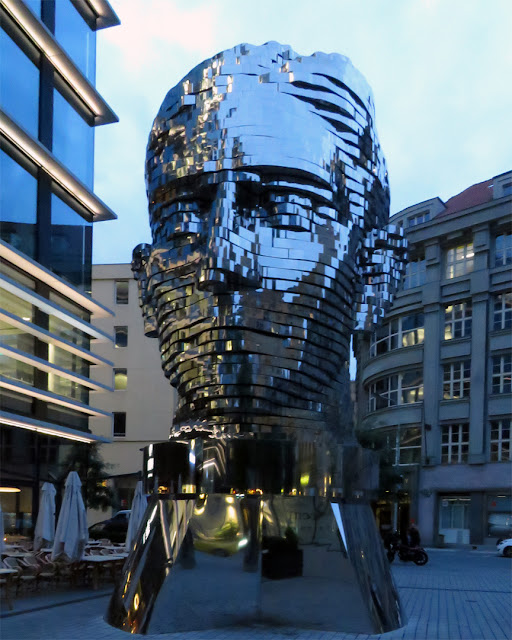
�K� (Franz Kafkas Head) by David Cern�, 2014 Quadrio Shopping Center Sp�len�, Nov� Mesto Prague, September 2017 �This eleven-metre-tall statue is a technical marvel of the 21st century in Prague. Forty-two moving panels rotate to create the face of the famous Czech writer Franz Kafka. The statue created by the artist David Cern� is installed near the Quadrio Shopping Centre and combines art with modern technology and the traditional �golden hands� of Czech craftsmen. Watch �The Metamorphosis�. Wait for all of the panels to align and discover the face of Kafka!� ( Franza Kafka Statue , Quadrio Shopping Center)

�K� Photo Sculpture

Image
�K� (Franz Kafka's Head) by David Cern�, 2014 Quadrio Shopping Center Sp�len�, Nov� Mesto Prague, September 2017 �This eleven-metre-tall statue is a technical marvel of the 21st century in Prague. Forty-two moving panels rotate to create the face of the famous Czech writer Franz Kafka. The statue created by the artist David Cern� is installed near the Quadrio Shopping Centre and combines art with modern technology and the traditional �golden hands� of Czech craftsmen. Watch �The Metamorphosis�. Wait for all of the panels to align and discover the face of Kafka!� ( Franza Kafka Statue , Quadrio Shopping Center)

Sign of the Times Photo Sculpture

Image
�Sign of the Times� by Steinbrener/Dempf & Huber, 2016 Hotel InterContinental Wien Johannesgasse (facade on Lothringerstrasse) Vienna, September 2017 �It is one of the iconic images of the silent film era: In the movie SAFETY LAST! (1923), the distinctive, stoic Harold Lloyd is dangling from the hand of a huge clock on the outside of a skyscraper in New York. He is turning to the viewer for help while the clock face is inevitably torn from its anchorage and slowly tilting forward. His double is currently dangling from a building in Vienna � not quite as high above the canyons of Manhattan as Harold Lloyd, but at least between the 7th and 8th floors of the Hotel InterContinental. His exact remake. As big as the movies. This creative and film-related intervention was conceived by the Viennese artist group Steinbrener/Dempf & Huber, who, in the past, have repeatedly attracted a great deal of attention with their actions in public spaces.� ( Sign of the Times , Viennale)

Cumil Photo Sculpture

Image
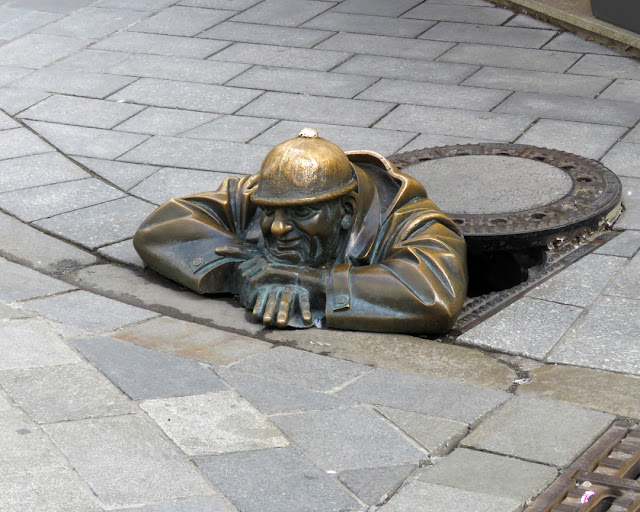
�Cumil� (The Watcher) by Viktor Hul�k, 1997 Ryb�rska Gate / Pansk� / Laurinsk� Bratislava, September 2017 �The literal translation of the word Cumil is �the watcher�. There are two possible explanations for its name. The first rumour says that he is a typical communist era worker who is not bothered about the work he�s supposed to be doing. According to the second rumour, hes looking under the women�s skirts. Choose the one you like more... This most photographed statue of our city attracts tourists at the junction of Laurinsk� and Pansk� Streets. Since 1997, when it was first embedded in the ground, it has become one of the symbols of our Old Town. There is a story around this man sticking out of a manhole. The story says that a wish will come true for you if you touch the head of the man � if you keep it secret forever.� ( Bratislava Statues , Welcome to Bratislava)

Cumil Photo Sculpture

Image
�Cumil� (The Watcher) by Viktor Hul�k, 1997 Ryb�rska Gate / Pansk� / Laurinsk� Bratislava, September 2017 �The literal translation of the word Cumil is �the watcher�. There are two possible explanations for its name. The first rumour says that he is a typical communist era worker who is not bothered about the work he�s supposed to be doing. According to the second rumour, he's looking under the women�s skirts. Choose the one you like more... This most photographed statue of our city attracts tourists at the junction of Laurinsk� and Pansk� Streets. Since 1997, when it was first embedded in the ground, it has become one of the symbols of our Old Town. There is a story around this man sticking out of a manhole. The story says that a wish will come true for you if you touch the head of the man � if you keep it secret forever.� ( Bratislava Statues , Welcome to Bratislava)

Pietro Metastasio Photo Sculpture

Image
Monument to Pietro Metastasio by Emilio Gallori, 1886 Piazza della Chiesa Nuova (Moved in 1910) Rome, April 2013

Man Hanging Out Photo Sculpture

Image
�Zave�en� mu�� (Man Hanging Out) by David Cern�, 1996 Husova, Star� Mesto Prague, September 2017 �Dangling above one of the cobblestone streets in Prague�s Old Town is a statue that has caused more than a few people to be concerned that a man is about to plummet to his death, but fear not, it is simply a fake Sigmund Freud. First created in 1996, the work known as �Zave�en� mu�� (Man Hanging Out) is the vision of Czech sculptor David Cern�, whose work can actually be found all across Prague. Many of Cerny�s works are seen as somewhat deliberately provocative, and this one is no different. The dangling Freud is surprisingly lifelike at a distance, and a number of people have sincerely taken it for a person in danger. However, it is simply a sculptural statement about intellectualism in the 20th century and Cern��s uncertainty about it.� ( Man Hanging Out , Atlas Obscura)

Scior Carera Photo Sculpture

Image
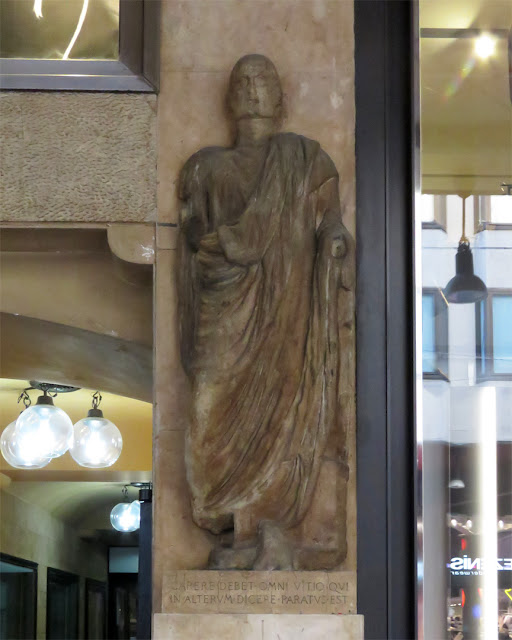
Scior Carera (Milanese for �Mister Carera�), Corso Vittorio Emanuele Milan, November 2016 �The name �Carera� is a corruption of the first word �Carere� of the epigraph found below the statue. The sculpture is a marble bas-relief dating back to the 3rd century. It depicts a man wearing a toga, with the right leg slightly put forward; it has lost its arms as well as its head. The latter was replaced in the middle ages, supposedly to represent archbishop Adelmanno Menclozzi. Under the relief there is an epigraph with a sentence credited to Cicero, Carere debet omni vitio qui in alterum dicere paratus est (�Anybody who wants to criticise someone should be free from all faults�). Another inscription below this one remembers the former collocation of the statue in Via San Pietro allOrto as well as the role this statue has played in the 19th century during the Austrian rule of Milan; at the time, in fact, there was the common habit of attaching satirical political messages to the statue, muc...

Scior Carera Photo Sculpture

Image
Scior Carera (Milanese for �Mister Carera�), Corso Vittorio Emanuele Milan, November 2016 �The name �Carera� is a corruption of the first word �Carere� of the epigraph found below the statue. The sculpture is a marble bas-relief dating back to the 3rd century. It depicts a man wearing a toga, with the right leg slightly put forward; it has lost its arms as well as its head. The latter was replaced in the middle ages, supposedly to represent archbishop Adelmanno Menclozzi. Under the relief there is an epigraph with a sentence credited to Cicero, Carere debet omni vitio qui in alterum dicere paratus est (�Anybody who wants to criticise someone should be free from all faults�). Another inscription below this one remembers the former collocation of the statue in Via San Pietro all'Orto as well as the role this statue has played in the 19th century during the Austrian rule of Milan; at the time, in fact, there was the common habit of attaching satirical political messages to the statue...