Posts

Showing posts with the label Bologna

Door Knocker Photo Sculpture

Image
A curious door knocker Via Saragozza Bologna, June 2015

Palazzo della Mercanzia Photo Sculpture

Image
Palazzo della Mercanzia by Lorenzo da Bagnomarino and Antonio di Vincenzo , 1391 Piazza della Mercanzia Bologna, June 2015 �Seat of the Chamber of Commerce, Industry, Agriculture and Crafts, Palazzo della Mercanzia has governed trading and business activities of Bologna since the late 14th century. In 1384 the building of Carrobbio open gallery (todays Mercanzia) was initiated under the direction of Antonio di Vincenzo and Lorenzo Bagnomarino in order to group together three buildings used as customs and toll house. For the gallery and the preparation of the hewn stone four stonecutters were called from Florence. The building was completed in 1391, but the elegant palace needed an extension in 1439 and restoration in 1484 following the fall of the de Bianchi tower. In 1888 - 90 it was reintroduced, also in its polychrome traits, under the direction of Rubbiani and Tartarini. It was rebuilt in 1949 after a live bomb blasted nearby had made half of the fa�ade collapse. Built in brick and...

Palazzo della Mercanzia Photo Sculpture

Image
Palazzo della Mercanzia by Lorenzo da Bagnomarino and Antonio di Vincenzo , 1391 Piazza della Mercanzia Bologna, June 2015 �Seat of the Chamber of Commerce, Industry, Agriculture and Crafts, Palazzo della Mercanzia has governed trading and business activities of Bologna since the late 14th century. In 1384 the building of Carrobbio open gallery (today's Mercanzia) was initiated under the direction of Antonio di Vincenzo and Lorenzo Bagnomarino in order to group together three buildings used as customs and toll house. For the gallery and the preparation of the hewn stone four stonecutters were called from Florence. The building was completed in 1391, but the elegant palace needed an extension in 1439 and restoration in 1484 following the fall of the de' Bianchi tower. In 1888 - 90 it was reintroduced, also in its polychrome traits, under the direction of Rubbiani and Tartarini. It was rebuilt in 1949 after a live bomb blasted nearby had made half of the fa�ade collapse. Built in...

Cloister of Santo Stefano Photo Sculpture

Image
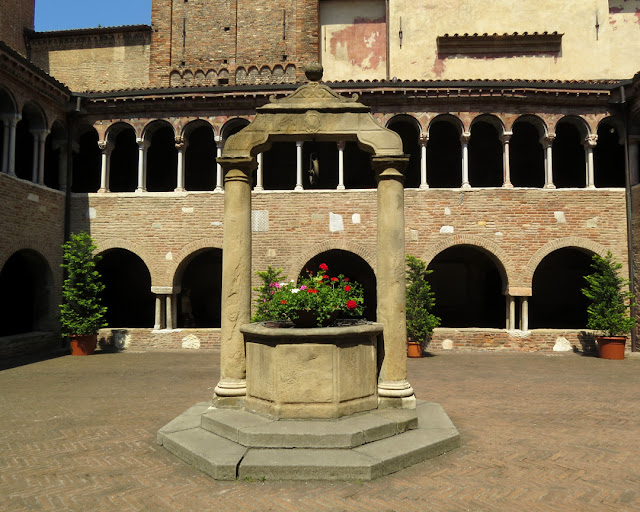
Cloister of the Basilica of Santo Stefano Piazza Santo Stefano Bologna, June 2015 �The focus of scholarly discussion has been for many years the supposed similarity between the so-called �New Jerusalem� rebuilt here, according to a vita written in 1180, by Saint Petronius in the 5th century, and the largely lost 4th-century complex erected by Constantine the Great at the purported site of the crucifixion and resurrection of Jesus. Unfortunately the archaeological evidence from Bologna dates primarily to the 11th and 12th centuries, leaving the question about an earlier date still unanswered (at least until 1981). On the other hand, archaeology has meanwhile delivered many answers regarding the Constantinian church complex from Jerusalem, therefore the main interest presented by the 12th-century parts of the Church of Santo Stefano might much rather be their similarity to the almost contemporary Crusader Church of the Holy Sepulchre from Jerusalem, of which not all parts are preserved.�...

Neptune Photo Sculpture

Image
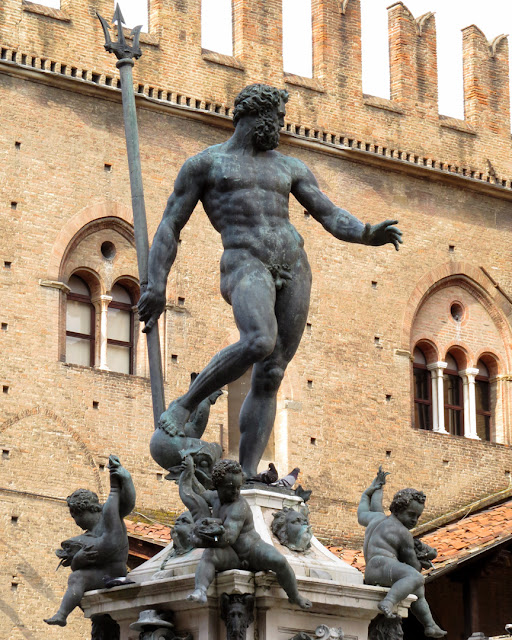
Statue of Neptune by Giambologna , 1567 Fountain of Neptune , Piazza del Nettuno Bologna, June 2015 �The Fountain of Neptune (Italian: Fontana di Nettuno) is a monumental civic fountain located in the eponymous square, Piazza del Nettuno, next to Piazza Maggiore, in Bologna, Italy. Its bronze figure of Neptune, extending his reach in a lordly gesture of stilling and controlling the waters, is an early work by Giambologna, completed about 1567. An innovation of Giambolognas fountain designs is the fantastic and non-geometrical forms he gave to the basins into which water splashed and flowed, �curiously folded, bulging and elastic in form�, as Rosalind Grippi remarked. The fountain is a model example of Mannerist taste of the courtly elite in the mid-sixteenth century: construction of the statue was commissioned by the Cardinal Legate of the city, Charles Borromeo, to symbolize the fortunate recent election of Borromeos uncle as Pope Pius IV. The work was designed by the Palermitan archi...

Neptune Photo Sculpture

Image
Statue of Neptune by Giambologna , 1567 Fountain of Neptune , Piazza del Nettuno Bologna, June 2015 �The Fountain of Neptune (Italian: Fontana di Nettuno) is a monumental civic fountain located in the eponymous square, Piazza del Nettuno, next to Piazza Maggiore, in Bologna, Italy. Its bronze figure of Neptune, extending his reach in a lordly gesture of stilling and controlling the waters, is an early work by Giambologna, completed about 1567. An innovation of Giambologna's fountain designs is the fantastic and non-geometrical forms he gave to the basins into which water splashed and flowed, �curiously folded, bulging and elastic in form�, as Rosalind Grippi remarked. The fountain is a model example of Mannerist taste of the courtly elite in the mid-sixteenth century: construction of the statue was commissioned by the Cardinal Legate of the city, Charles Borromeo, to symbolize the fortunate recent election of Borromeo's uncle as Pope Pius IV. The work was designed by the Palerm...

Lucio Dalla Photo Sculpture

Image
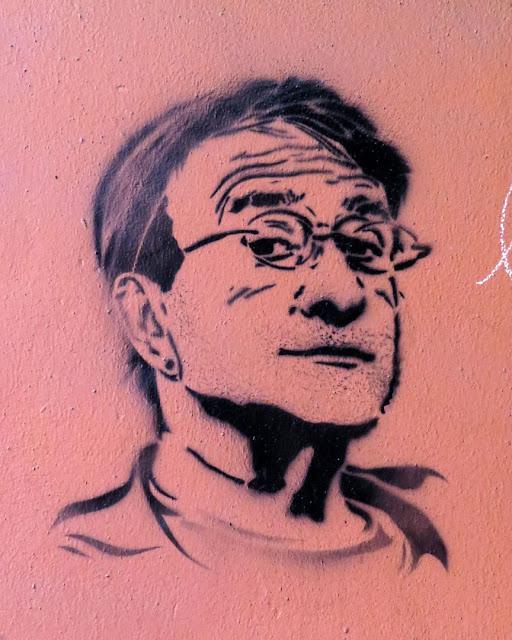
Stenciled Lucio Dalla Piazza de Celestini Bologna, June 2015 �As the title of one of his most famous songs states, Lucio Dalla was born on March 4, 1943, and became one of the most important, as well as most popular, figures in Italian pop music of the second half of the 20th century. Dallas career was a fascinating musical rollercoaster through several distinct periods. More than once he managed to enrapture and then enrage fans and critics with his sudden changes of musical direction, which were, as is often the case in Italy, invariably perceived as sheer ideological betrayals. Still, at the same time that he was alienating one audience, he was attracting a new and often bigger one. Typically unfazed by controversy, Dalla never let criticism get behind his perennial sad buffoon fa�ade, and kept doing things his way, even at the risk of self-parody. By the early 21st century, Dalla had long become an untouchable icon of Italian pop culture as everybodys favorite mischievous uncle.� (...

Lucio Dalla Photo Sculpture

Image
Stenciled Lucio Dalla Piazza de' Celestini Bologna, June 2015 �As the title of one of his most famous songs states, Lucio Dalla was born on March 4, 1943, and became one of the most important, as well as most popular, figures in Italian pop music of the second half of the 20th century. Dalla's career was a fascinating musical rollercoaster through several distinct periods. More than once he managed to enrapture and then enrage fans and critics with his sudden changes of musical direction, which were, as is often the case in Italy, invariably perceived as sheer ideological betrayals. Still, at the same time that he was alienating one audience, he was attracting a new and often bigger one. Typically unfazed by controversy, Dalla never let criticism get behind his perennial sad buffoon fa�ade, and kept doing things his way, even at the risk of self-parody. By the early 21st century, Dalla had long become an untouchable icon of Italian pop culture as everybody's favorite mischi...

Casa Isolani Photo Sculpture

Image
Casa Isolani (Isolani House) Strada Maggiore Bologna, Jene 2015 �Dominating the entrance to Strada Maggiore, one of the main streets of Medieval Bologna, is the doorway to the Casa Isolani. This is one of the most interesting examples of Roman-Gothic architecture in Bologna. The tall wood structure marks the beginning of the Corte Isolani, a covered passageway that connects two of the most monumental areas of Bologna. The complex of Isolani buildings, restored and opened to the public in 1999, still belongs to the family that gave it its name. It crosses the courtyards and atriums that line the shops, offices, and residences, continuing all the way to the Piazza Santo Stefano.� ( Corte Isolani , ItalyGuides.it)

Arco del Meloncello Photo Sculpture

Image
Detail of the Arco del Meloncello , by Carlo Francesco Dotti, 1732 Via Saragozza Bologna, June 2015 �The Arco del Meloncello is an 18th-century Rococo structure in Bologna, that forms a pedestrian portico over the road (hence an arch); it is part of the Portico di San Luca, a long arcade that sheltered the walk from the Cathedral of Bologna to the hillside Sanctuary of San Luca, Bologna. It lies beyond the gates of the Porta Saragozza, outside the former city walls of Bologna. The arch solved the problem of a site where two roads intersected at right angles, and allowed the foot traffic of the pilgrims to proceed above the road, Via Saragozza, uninterrupted. The architect was Carlo Francesco Dotti won the commission during a competition in 1714, and created the scenographic arrangement with the help of Francesco Galli Bibiena during 1721 to 1732. In the early twentieth century, in a project supervised by Tito Azzolino, the arch was raised a few meters to allow passage of a train under...